“We must, I mean we must block facebook!” demanded Mr. Gradgrind. Tom could see no reason to fight the ban. He just worked out a proxy solution and blamed Stephen. Tom was free to bully and manipulate. He just trolled and trolled. I mean he knew no better. A facts based education does this to a man. A parody of Hard Times by Dickens in 2016.
There is a school thought that supports all that technology can help with in the classroom. 21st CLD encourages collaboration, knowledge construction, self-regulation, real-world problem-solving and innovation, the use of ICT for learning and skilled communication. Using social media such as facebook or, since this is a BLOG about our journey into GAFE, Google +, which is disabled, ironically, at our school too :-o (surprise btw). Social media benefits learning students, no my children, use it to talk to each and talk is used to construct learning. In essence a decision has been taken, generally unilaterally to block those means of communication, those means of constructing learning because talk can be used to bully, troll and of course it is a distraction. Is Youtube a social media site? That is a distraction for students, in my opinion, but I don’t block it.
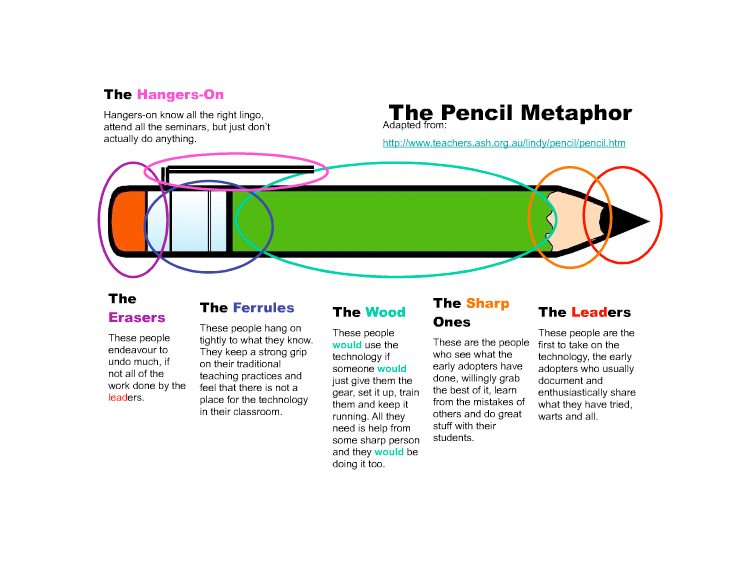
When it comes to digital technology and digital tools in the classroom teachers can be categorised on a continuum defined by the pencil analogy from teach thought.

Some teachers are able to weave new ideas, technological or just transformative, into their classrooms. Some teachers will use the ‘internet’ in positive ways to enhance learning by creating and using tools to engage students. Other teachers, however, use the ‘internet’ to allow student to consume content and have not yet grasped the interactivity or the capability of some social media sites to enable student to create and make. Teachers will need PLD in these areas and they do need to take cognisance of the issues surrounding SM (Social Media). However, they are extremely well supported by such organisations as Netsafe who provide frameworks for educators to be able to teach sensible use of SM the netsafe kit is one such resource that can help teachers educate their students to act and behave responsibly online. However, there are some teachers who know their way around a computer and they also need to be reined in when using public networks and openly visible social media sites. Netsafe also provides solutions for this with staff usage agreements too. I am one of those people that knows their way around a computer ;-)
Some teachers are able to weave new ideas, technological or just transformative, into their classrooms. Some teachers will use the ‘internet’ in positive ways to enhance learning by creating and using tools to engage students. Other teachers, however, use the ‘internet’ to allow student to consume content and have not yet grasped the interactivity or the capability of some social media sites to enable student to create and make. Teachers will need PLD in these areas and they do need to take cognisance of the issues surrounding SM (Social Media). However, they are extremely well supported by such organisations as Netsafe who provide frameworks for educators to be able to teach sensible use of SM the netsafe kit is one such resource that can help teachers educate their students to act and behave responsibly online. However, there are some teachers who know their way around a computer and they also need to be reined in when using public networks and openly visible social media sites. Netsafe also provides solutions for this with staff usage agreements too. I am one of those people that knows their way around a computer ;-)
For my own personal development, do you know what? my best source of PD comes from my FACEBOOK feed. I check it daily, upwards of 5 times a day. It has been trained and programmed to reflect my interests. Since both my wife and I are teachers we have a joint account facebook presence, shhh don’t tell Facebook! I am really enjoying the posts from MINDSHIFT at the moment and they help to challenge my thinking with respect to current educational trends. It certainly is a break from the mundanity of administration, credit acquisition and office politics.
I also engage with Google + and especially GEG Community, Google Educators Group. This resulted helped me find a resource that can help a member of my department in developing his skills in being able to teach DVC. Karen Ferguson's google site for DVC has proved to be a very useful tool in our department to begin the process of inspiring others.
Finally, earlier on in this MINDLAB course I surveyed teachers, on the course, and asked them about social media, specifically how they use it in class the results for our group surprised me as I thought it would be much less, 36% used SM in class and 64% didn’t. I know at our school we still have a long way to go.
References
(2008). Urban Dictionary: Internet Troll. Retrieved March 4, 2016, from http://www.urbandictionary.com/define.php?term=Internet%20Troll.
(2013). How Students Benefit From Using Social Media - Edudemic. Retrieved March 4, 2016, from http://www.edudemic.com/how-students-benefit-from-using-social-media/.
(2014). Teachthought.com. Retrieved 5 March 2016, from http://www.teachthought.com/uncategorized/pencil-metaphor-how-teachers-respond-to-education-technology/
(2015). Children's Engagement with Talk to Enhance Learning in ... Retrieved March 4, 2016, from https://thecriticalblog.wordpress.com/2015/05/14/childrens-engagement-with-talk-to-enhance-learning-in-the-primary-school-classroom-literature-review/.
(2015). The Pencil Metaphor: How Teachers Respond To Education ... Retrieved March 5, 2016, from http://www.teachthought.com/uncategorized/pencil-metaphor-how-teachers-respond-to-education-technology/.
(2015). YouTube overtakes Facebook as the web's biggest social ... Retrieved March 4, 2016, from http://www.brafton.com/news/youtube-overtakes-facebook-webs-biggest-social-network/

No comments:
Post a Comment