Integrating Technology and Literacy: A middle school language arts educator shares his favorite digital tools for text and video annotations, teacher feedback, and formative assessment.
Monday, 28 March 2016

Friday, 11 March 2016
Activity 10: REFLECTION and GOALS
All good things…
Well, it has been 32 weeks since the beginning of this journey. One I started by missing week 1. I was in Samoa on a school trip. However, that did not impinge on the following weeks. The first 16 weeks experiencing new teaching methods was interesting and I love the techie bit. Discussing a topic for an hour and then using a technology to create something about the topic brought us altogether. A team at the table. Did I mention I loved the techie bit?
This course has enabled me to lead some developments in technology and share some tools with staff. GAFE apps plus some new ones to help staff move into a more creative area for learning. Kahoot I had never seen before, nor blendspace, nor Aurasma and these created a bit of a stir amongst our staff. It has led to a situation where staff want to learn more. In 2016 I have already been asked to deliver PL sessions with a digital tools focus. Influencing the appraisal system in 2015 to include an e-Learning requirement involving SAMR helped lead all staff towards thinking in a more 21st way.
GAFE is a set of tools, just like a chalk board and a piece of chalk or an authoritarian approach to instruction; they are just tools. This course has reawakened by need to engage at a professional level discussing modes of pedagogy. What works and what doesn’t. The Educultural wheel, constructivism, growth mindset and change knowledge discussed by Michael Fullan in his book Stratosphere have all impacted on my practice in some way. One area in this field was the discussion around design thinking in education. I teach Technology in a secondary school and design thinking is a fundamental requirement for our course. It was a very warm feeling to see one of your core values being spoken about as a means to engage change in the classroom. Discussing these points at staff PLs and running workshops for individuals, Thursday after school, helps teachers think about these areas in their own practice. All staff have now been challenged to think about 21st C learning design using 21st CLD evaluative survey, constructed using Google Docs.
Digital citizenship (DC) as a part of my practice I lead the ICT committee across the school. Members range from different departments but we meet monthly to discuss emerging issues and plans. This year the student use agreement has been changed to promote good digital citizenship. All tutors will discuss this with their tutor classes and all teachers have a tutor class. All students have a PSK (private security key) and are now able to effectively engage with BYOD. Hence digital citizenship is a must.

I am also trying blogs with my construction class (one example here) and department members. It is a real opportunity to create and reflect WITHOUT the need for assessment!
Future school plans
Continue developing staff - plan a programme of PL for all staff based on targeted surveys and individual support to upskill in the areas of pedagogy linked to using digital tools. Remove SAMR from appraisal and replace with 21st CLD.
Develop the use of tablet technology with the technology department in conjunction with the Maths and Samoan departments to use 7” tablet devices for blogging purposes where students can actively generate their own images and write about them in meaningful ways.
Personal development
I would also like to research what it means to be Google Educator to better equip me to use the GAFE suite for me as an individual and as a teacher in a GAFE school.
I am considering seeking out a masters programme that takes me into the applied practice areas. Using tools to enhance learning and developing programmes responsive to student needs in a Pasifika context.
… all good things never end...
References
(2015). Criteria 5 / Practising Teacher Criteria and e-learning ... Retrieved March 12, 2016, from http://elearning.tki.org.nz/Professional-learning/Practising-Teacher-Criteria-and-e-learning/Criteria-5.
(2015). Criteria 6 / Practising Teacher Criteria and e-learning ... Retrieved March 12, 2016, from http://elearning.tki.org.nz/Professional-learning/Practising-Teacher-Criteria-and-e-learning/Criteria-6.
(2015). Criteria 7 / Practising Teacher Criteria and e-learning ... Retrieved March 12, 2016, from http://elearning.tki.org.nz/Professional-learning/Practising-Teacher-Criteria-and-e-learning/Criteria-7.
(2014). 21CLD Learning Activity Rubrics - FCL. Retrieved March 12, 2016, from http://fcl.eun.org/documents/10180/14691/5.3x+-+21cld+learning+activity+rubrics+2012.pdf/e240da11-07c2-4633-a86e-06c12f00d8ad?version=1.0.
(2015). Google for Education: Training Center. Retrieved March 12, 2016, from https://edutrainingcenter.withgoogle.com/.
Fullan, M. (2013). Stratosphere: Integrating Technology, Pedagogy, and Change Knowledge: Pearson
Activities 9 : Evaluations of the cultural responsiveness in practice
As a Welshman, living in Wales, I grew up with an appreciation of hegemony. Culturally responsive pedagogy is a way in which indigenous knowledge can be affirmed. It is refreshing to work in New Zealand’s bicultural education system where indigenous knowledge is held in high regard, whilst not losing sight of the blended nature and developmental history of Aotearoa. Wales, whilst an old nation, is still struggling with its place in British society. There is much opposition to positive discrimination, especially around compulsory language lessons. Wales has not yet appreciated the bicultural nature of itself in the 21st Century, when, in law it is bilingual.
For me, knowledge of the indigenous cultures and responding to this in the classroom is another tool available to the teacher and can be applied in varying degrees dependent on the class concerned. Teaching in a ‘Pasifika school’ where there are few Pakeha, but many pacific islanders, indigenous knowledge and relationship connections are important to establish and build upon.
Culturally responsive assessments
Some exemplars and contexts for assessments provided by the NZQA are designed with Pakeha in mind. Our school has a pasifika profile.
A maths standard at our school demanded that students calculate percentages and so the department created an assessment where students would calculate how long it would take to
repay a credit card loan considering APR rates and repayments over time. The results were poor. The engagement of the students was poor. The connection between the topic discussed and the students’ own personal experiences was just not there. None, or very few, of the family, had credit cards and therefore didn’t understand the fundamental principles involved. When they changed their percentage assessments to calculating excess in construction orders for construction jobs e.g. you need 19M of 100mm x 50mm rough sawn timber to create a fence, calculate the excess for loss (in cuts and length, since timber is delivered in 5.1 metre lengths) loss of 10% is acceptable for example. Results and class engagement improved. The assessment was changed to be more appropriate for day to day culture that families are exposed to, not just the historical nature of cultural identity.
Communication methods
I will approach this by considering the Pasifika education plan and Te kotahitanga. Traditional, European, even Victorian, styles of pedagogy may not always work with all students. New Zealand’s indigenous culture respond well to collective communications and constructing activities based on groups. Assessments are not always well received when presented for individuals to complete. However, if learning is communicated in such a way that it can be shared with Whanau, Ainga and discussed at home then the whole community can be involved together to advance both the team and the individual. Using a blog, for example, has been a great way to share experiences with home and so far it is proving to be a good way to connect to home. The school is still producing communications in paper form, letters, newsletter and so on. These are translated in the main for the families of the students. Each culture has a leader and they beginning to embrace the 21st Century agenda using telecommunications in terms of email, mobile technologies and the now ‘traditional chromebook’! Teachers are using social media to affirm students achievements and as Polyfest approaches it is a great way to share students work and passions.
There is more work to be done in this area engaging parents and communities with our Google Apps for Education project and especially in connecting via social media the Educultural Wheel may be useful tool to apply in this situation.

Perhaps a school App may help raise this profile!!
References:
Click on Wales » Blog Archive » The trouble with bilingual ..." 2014. 7 Mar. 2016 <http://www.clickonwales.org/2014/11/the-trouble-with-bilingual-education-the-ever-increasing-gap-between-research-policy-and-practice/>
Click on Wales » Blog Archive » The trouble with bilingual ..." 2014. 7 Mar. 2016 <http://www.clickonwales.org/2014/11/the-trouble-with-bilingual-education-the-ever-increasing-gap-between-research-policy-and-practice/>
(2010). Te Kotahitanga - Home - Te Kotahitanga. Retrieved March 11, 2016, from http://tekotahitanga.tki.org.nz/.
(2014). Pasifika Education Plan 2013-2017 | Education in New ... Retrieved March 11, 2016, from http://www.education.govt.nz/ministry-of-education/overall-strategies-and-policies/pasifika-education-plan-2013-2017/.
(2014). The Educultural Wheel. Retrieved March 11, 2016, from http://www.vln.school.nz/file/download/852642.
(2016). Alternative Wales: End Cymraeg Coercion.Walesuk.blogspot.co.nz. Retrieved 7 March 2016, from http://walesuk.blogspot.co.nz/p/end-cymraeg-coercion.html
Activity 8: Ethics - continued
So this week I have been thinking about ethics of taking images for a Technology class. The Mindlab does that to my brain, it seems to awaken corners of my soul that I knew were there, but I just used to ignore. Anyway, what about this? I mean I am just putting it out there so to speak...

Scenario: a student (student A) takes a picture of another student's work (student B) because student B does not have a device. Student A uploads to Google Classroom for student B to use in his work. Then the students have a falling out and student A goes home and uploads the image to a social media site to mock student B.
DILEMMA - Who owns the image and what rights do either the school or the student have in regard to asking the image down.
So, off I go to Google + and GEG community therein and also the MINDLAB community and other Google educator sites
So, as it stands this is what I think:
An image taken in school is subject to privacy act especially principle 5 in relation to unauthorised use and unauthorised disclosure. Therefore, it is incumbent upon the school to apply a responsible use agreement with students. A parents agreement will also need to be applied.
The person taking the image owns the copyright unless the IP in the image is owned or commissioned by an organisation. Therefore, in this example, the school commissioned the project and therefore it can be argued that the IP in the image is owned by the school.
Student A has breached privacy, copyright and responsible use agreement and thus can be asked to take the image down.
Phew that took some unpicking and I would like to acknowledge the following for their help in engaging my thought processes, thank you very much.
Leigh Hynes
Darcy Vo
Rob Clarke

Scenario: a student (student A) takes a picture of another student's work (student B) because student B does not have a device. Student A uploads to Google Classroom for student B to use in his work. Then the students have a falling out and student A goes home and uploads the image to a social media site to mock student B.
DILEMMA - Who owns the image and what rights do either the school or the student have in regard to asking the image down.
So, off I go to Google + and GEG community therein and also the MINDLAB community and other Google educator sites
So, as it stands this is what I think:
An image taken in school is subject to privacy act especially principle 5 in relation to unauthorised use and unauthorised disclosure. Therefore, it is incumbent upon the school to apply a responsible use agreement with students. A parents agreement will also need to be applied.
The person taking the image owns the copyright unless the IP in the image is owned or commissioned by an organisation. Therefore, in this example, the school commissioned the project and therefore it can be argued that the IP in the image is owned by the school.
Student A has breached privacy, copyright and responsible use agreement and thus can be asked to take the image down.
Phew that took some unpicking and I would like to acknowledge the following for their help in engaging my thought processes, thank you very much.
Leigh Hynes
Darcy Vo
Rob Clarke
Saturday, 5 March 2016
Activity 8: Ethics
A decile 1 school has wifi access and allows all students and staff access to the internet. The school has secure filtering and blocks sites that have adult content. The school has a policy for mobile phones. They are permitted in schools but are not allowed out in class. The school has a BYOD policy, most, but not all students bring phones, some do not bring anything at all. School has adopted the netsafe student responsible usage agreement. The school has included a tick box on enrolment covering the use of images for publicity and use on websites and newsletters.
The NZQA has expressly challenged schools to think of new ways to record evidence of student performances for moderation purposes and it is the intention of the NZQA to transform assessment.
Scenario: Students in a construction class have been challenged to record evidence of their practical work and reflect using a blog. The images of the practical work contain images of fellow students, and their work, taken on their phones. Some students have been posting these images on social media when they return home along with comments in relation to other student performances. One Tongan parent complained when a student denigrated their son, on social media, for a poorly made project, in their native Tongan language. The teacher was not aware until the cultural leader brought it to the attention of the teacher. The parent expressed concern that school work was being shared publically and that images taken, by students, were being used by students for unethical purposes.

In this case, there are number of issues to consider:
- publically available evidence of student work, broadcast world-wide, on a student blogs
- student device usage and the purpose of the images. Who owns the image of a school project for example?
- native language used to denigrate other students
- school imagery linked to gang culture
Blogs
“Teachers nurture the capacities of all learners to think and act with developing independence, and strive to encourage an informed appreciation of the fundamental values of a democratic society.” Code of Ethics for Registered Teachers in New Zealand
The blog is a useful tool to share work and since “The profession is a knowledge-building community. As a member of the profession a teacher should seek and respond to opportunities to share knowledge and discuss concerns.” In this case the teacher can speak with the parent concerned with a view to appease and protect the fundamental nature of sharing student learning. It is great that a parent is taking interest in what students create and share as part of their learning. The teacher could explore the possibility of involving the parent in the process by providing comments on work observed. In this way the teacher is addressing the principle that Social media provides a great opportunity to collaborate and communicate with parents and family. Social media can provide a window into a school/centre so that ideas and information can be shared and exchanged all the time.
Rights to use the images
Students need to be reminded of their obligations under the responsible usage. Once again this is a teaching moment. Students need to be advised that any images they take of work commissioned in school is owned by the school.
"...in relation to photographs, … if the author was commissioned to make the work, the person who commissioned the work may own copyright in the work ( – subject to an agreement to the contrary).” Copyright guidance for schools, TKI.
So the fact that the image is on their phone means that students can be asked, by the teacher, to surrender their phone and images can be deleted.
Language use
The implication here is that the language used to denigrate is Tongan and the teacher doesn’t speak Tongan. So what! Ethically speaking “Teachers are entrusted with the care and education of learners. Teachers who model good social media use will grow learners who apply positive, respectful values in their interactions on social media platforms. These skills will equip them for life beyond school in an increasingly digital world.” An insult is an insult. The language doesn’t matter, since the teacher may not be friends with the student on Facebook and would not be aware of the insult. At this point it is imperative the teacher visits the teaching moment of decisions taken by the protagonist and speaks with the cultural leader and the family of both the protagonist and the injured party, to apply the principles of social justice and the school’s restorative behaviour model.
Gang Culture
Is all gang culture bad? Is MOTUGANG a bad gang? Fullan (2013) speaks of using the team to benefit the outcomes for all members of the team. Once again a teaching moment applies here and by addressing the commitment to ALL learners a discussion around encouraging learners to think critically about significant social issues, may open up the features of this gang. Can all members of the class join? What are the aims? Is it a gang in the sense of the word as explored by Gilbert.

It is safe to assume this is not permissible in this school where illegal gang culture is a real issue. So when school images are linked to gangs the teacher needs to hold the discussion with the student, and ask them to remove, or, at least, update the status comment, to reflect more positively the image and the intentions of the course.
References
(2012). the netsafe kit for schools. Retrieved March 5, 2016, from http://www.netsafe.org.nz/the-kit/policy-and-use-agreements.
(2012). Teachers & Social Media | Commitment to Parents ... Retrieved March 5, 2016, from http://teachersandsocialmedia.co.nz/guidelines/commitment-parentsguardians-and-familywh%C4%81nau
(2012). Teachers & Social Media | Commitment to the Profession. Retrieved March 5, 2016, from http://teachersandsocialmedia.co.nz/guidelines/commitment-profession.
Teachers & Social Media | Commitment to Society. Retrieved March 5, 2016, from http://teachersandsocialmedia.co.nz/guidelines/commitment-society.
(2014). Innovation at NZQA » NZQA. Retrieved March 5, 2016, from http://www.nzqa.govt.nz/about-us/innovation-at-nzqa/.
(2015). NZQA's Digital Assessment Transformation. Retrieved March 5, 2016, from http://www.nzqa.govt.nz/assets/About-us/Our-role/innovation/DA-Factsheet-May15.pdf.
(2015). What is copyright? / For students / Guidelines for schools ... Retrieved March 5, 2016, from https://www.tki.org.nz/Copyright-in-Schools/Guidelines-for-schools/For-students/What-is-copyright.
(2016). Code of Ethics for Registered Teachers in New Zealand. Retrieved March 5, 2016, from http://educationcouncil.org.nz/required/ethics/codeofethics.stm.
Inside the culture of gangs. (2013). Stuff. Retrieved 5 March 2016, from http://www.stuff.co.nz/national/crime/8464475/Inside-the-culture-of-gangs
Fullan, M. (2013). Stratosphere: Integrating Technology, Pedagogy, and Change Knowledge: Pearson
Friday, 4 March 2016
Activity 7: Don't block FACEBOOK
Do you know what? Don’t block facebook. There, I said it. I am a teacher and I mean it. Just stop the obsession with control and coercion in secondary schools. Guess what? Kids use social media to make some great decisions. They collaborate, they contact one another and talk about learning outside of the classroom. Do you know something? Some students tag on the walls and desks in my school, I know shhh don’t tell. When that happens, and we find the culprit, do we take all of their pens away and send them to English with the express instruction: Do not use a pen or pencil for the rest of the day? Nope. If they play a game in ICT we take away their computer privileges for the day and they can't contribute... sigh!
(2015). YouTube overtakes Facebook as the web's biggest social ... Retrieved March 4, 2016, from http://www.brafton.com/news/youtube-overtakes-facebook-webs-biggest-social-network/
“We must, I mean we must block facebook!” demanded Mr. Gradgrind. Tom could see no reason to fight the ban. He just worked out a proxy solution and blamed Stephen. Tom was free to bully and manipulate. He just trolled and trolled. I mean he knew no better. A facts based education does this to a man. A parody of Hard Times by Dickens in 2016.
There is a school thought that supports all that technology can help with in the classroom. 21st CLD encourages collaboration, knowledge construction, self-regulation, real-world problem-solving and innovation, the use of ICT for learning and skilled communication. Using social media such as facebook or, since this is a BLOG about our journey into GAFE, Google +, which is disabled, ironically, at our school too :-o (surprise btw). Social media benefits learning students, no my children, use it to talk to each and talk is used to construct learning. In essence a decision has been taken, generally unilaterally to block those means of communication, those means of constructing learning because talk can be used to bully, troll and of course it is a distraction. Is Youtube a social media site? That is a distraction for students, in my opinion, but I don’t block it.
When it comes to digital technology and digital tools in the classroom teachers can be categorised on a continuum defined by the pencil analogy from teach thought.

Some teachers are able to weave new ideas, technological or just transformative, into their classrooms. Some teachers will use the ‘internet’ in positive ways to enhance learning by creating and using tools to engage students. Other teachers, however, use the ‘internet’ to allow student to consume content and have not yet grasped the interactivity or the capability of some social media sites to enable student to create and make. Teachers will need PLD in these areas and they do need to take cognisance of the issues surrounding SM (Social Media). However, they are extremely well supported by such organisations as Netsafe who provide frameworks for educators to be able to teach sensible use of SM the netsafe kit is one such resource that can help teachers educate their students to act and behave responsibly online. However, there are some teachers who know their way around a computer and they also need to be reined in when using public networks and openly visible social media sites. Netsafe also provides solutions for this with staff usage agreements too. I am one of those people that knows their way around a computer ;-)
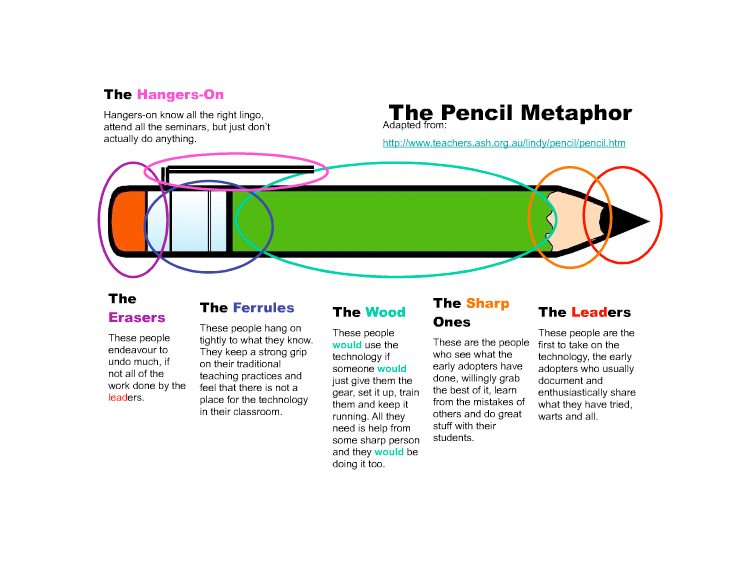
Some teachers are able to weave new ideas, technological or just transformative, into their classrooms. Some teachers will use the ‘internet’ in positive ways to enhance learning by creating and using tools to engage students. Other teachers, however, use the ‘internet’ to allow student to consume content and have not yet grasped the interactivity or the capability of some social media sites to enable student to create and make. Teachers will need PLD in these areas and they do need to take cognisance of the issues surrounding SM (Social Media). However, they are extremely well supported by such organisations as Netsafe who provide frameworks for educators to be able to teach sensible use of SM the netsafe kit is one such resource that can help teachers educate their students to act and behave responsibly online. However, there are some teachers who know their way around a computer and they also need to be reined in when using public networks and openly visible social media sites. Netsafe also provides solutions for this with staff usage agreements too. I am one of those people that knows their way around a computer ;-)
For my own personal development, do you know what? my best source of PD comes from my FACEBOOK feed. I check it daily, upwards of 5 times a day. It has been trained and programmed to reflect my interests. Since both my wife and I are teachers we have a joint account facebook presence, shhh don’t tell Facebook! I am really enjoying the posts from MINDSHIFT at the moment and they help to challenge my thinking with respect to current educational trends. It certainly is a break from the mundanity of administration, credit acquisition and office politics.
I also engage with Google + and especially GEG Community, Google Educators Group. This resulted helped me find a resource that can help a member of my department in developing his skills in being able to teach DVC. Karen Ferguson's google site for DVC has proved to be a very useful tool in our department to begin the process of inspiring others.
Finally, earlier on in this MINDLAB course I surveyed teachers, on the course, and asked them about social media, specifically how they use it in class the results for our group surprised me as I thought it would be much less, 36% used SM in class and 64% didn’t. I know at our school we still have a long way to go.
References
(2008). Urban Dictionary: Internet Troll. Retrieved March 4, 2016, from http://www.urbandictionary.com/define.php?term=Internet%20Troll.
(2013). How Students Benefit From Using Social Media - Edudemic. Retrieved March 4, 2016, from http://www.edudemic.com/how-students-benefit-from-using-social-media/.
(2014). Teachthought.com. Retrieved 5 March 2016, from http://www.teachthought.com/uncategorized/pencil-metaphor-how-teachers-respond-to-education-technology/
(2015). Children's Engagement with Talk to Enhance Learning in ... Retrieved March 4, 2016, from https://thecriticalblog.wordpress.com/2015/05/14/childrens-engagement-with-talk-to-enhance-learning-in-the-primary-school-classroom-literature-review/.
(2015). The Pencil Metaphor: How Teachers Respond To Education ... Retrieved March 5, 2016, from http://www.teachthought.com/uncategorized/pencil-metaphor-how-teachers-respond-to-education-technology/.
(2015). YouTube overtakes Facebook as the web's biggest social ... Retrieved March 4, 2016, from http://www.brafton.com/news/youtube-overtakes-facebook-webs-biggest-social-network/
Subscribe to:
Comments (Atom)